
by Cathy Cuff-Coffman
When “For better and for worse” is put to its test.
According to a study done by the AARP (American Association of Retired Persons) in 2020, more than 1 in 5 Americans (21.3 percent) are caregivers, totaling an estimated 53.0 million adults in the United States, up from the estimated 43.5 million caregivers in 2015.
When looking at caregivers for adults only, the prevalence of caregiving has risen from 16.6 percent in 2015 to 19.2 percent in 2020—an increase of more than eight million adults providing care to a family member or friend age 18 or older.
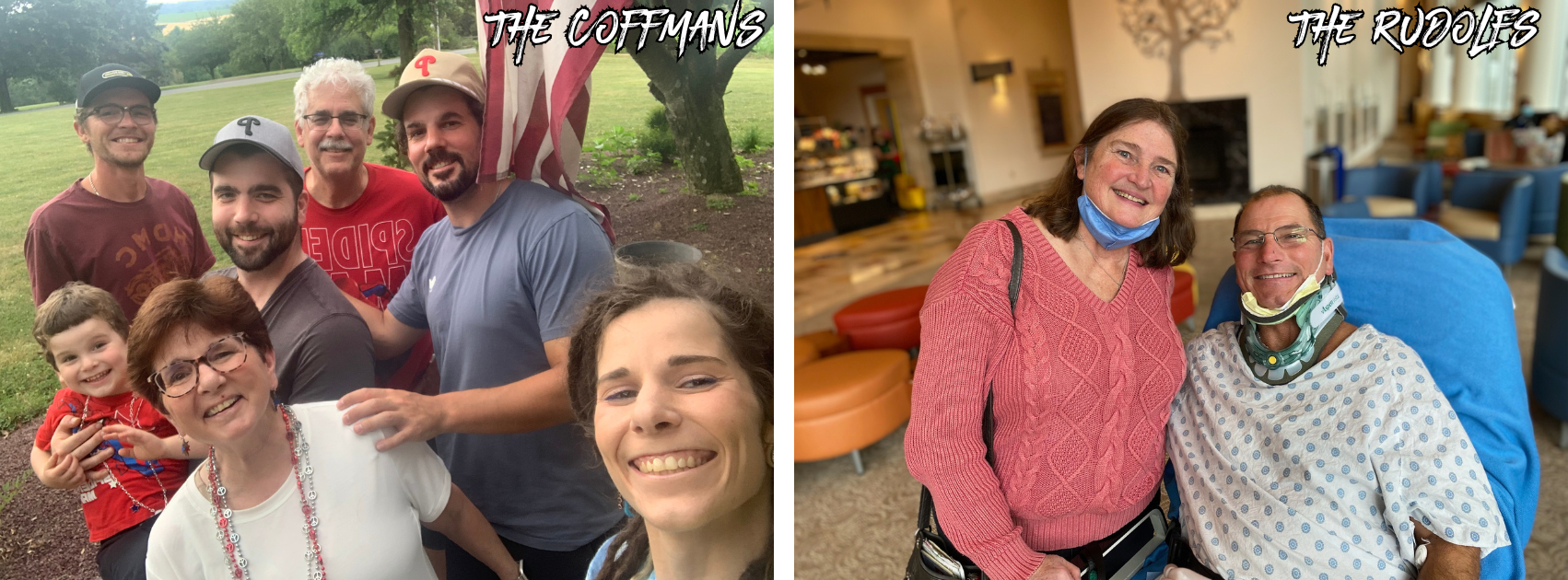
At The Ryan Shazier Fund Family, we’re no strangers to the struggles and successes of unpaid family caregiving. Meet the Rudolfs from Oregon, and the Coffmans from Pennsylvania–two married couples in their early 60s who were both dealt similar caregiving card hands.
Mitch and Deb Rudolf met when they were both 22. “My sister worked nights at a bar, and I’d stop by to see her after my day shifts,” recounts Deb. “It felt like our own version of Cheers, where everyone knew each other.” She says Mitch stood out with his broken arm in a cast. “I saw him there all summer but never spoke to him—until one night, while I was playing Pac-Man, he came up and asked me out.”
Soon after their first date, they wed. “We’ve been married ever since—40 years this September.”
The Rudolfs are originally from Connecticut but moved to Oregon in 2022 to be closer to their daughters and grandchildren.
Long Marriages
Similarly, Jamie and Cathy Coffman met in their early 20s. “We both lived in a privately run dorm at West Virginia University,” says Cathy. Jamie was finishing up his master’s degree in civil engineering, and Cathy was earning a news-ed journalism degree and a jazz (saxophone) performance minor. “We were both in a long-distance running club too,” says Jamie. “We shared a love of fitness, the outdoors, and appreciated each other’s different talents.”
They married right after graduation in 1984; 41 years ago.
Mitch and Cathy met in 2023 via a Zoom exercise class for people with Spinal Cord Injuries (SCI). The classes were first offered by Stephanie Comella’s Zebrafish Neuro, and have now spun off to Barry Moore and his Ireland-based Vitality Neuro Rehabilitation online training offering. Moore came to America to study with Comilla. The online class, though small, is a true group of friends supporting each other akin to “Lightning in a Bottle.”
Before caregiving, Deb Rudolf was a retail pharmacist for 40 years. Eventually, she and Mitch moved from Connecticut to Oregon to be near grandkids. “We thought retirement would come gradually, maybe part-time work and travel,” she says. “But not long after moving, Mitch (a successful, self-employed contractor) fell and got injured—and life shifted dramatically.”
The Coffmans were in a similar situation. Jamie was working full time as an engineering group manager. Cathy was managing a flexible workspace solutions and freelance writing. She also fell and broke her neck while making a baby shower poster board for her daughter. Both Mitch and Cathy have cervical spinal cord injuries and all the associated physical problems.
Deb continues: “We were in a new place with no doctors, no care network, and no idea how the system worked. I was terrified. In Connecticut, I knew which doctors to trust. Out here, everything was unfamiliar.”
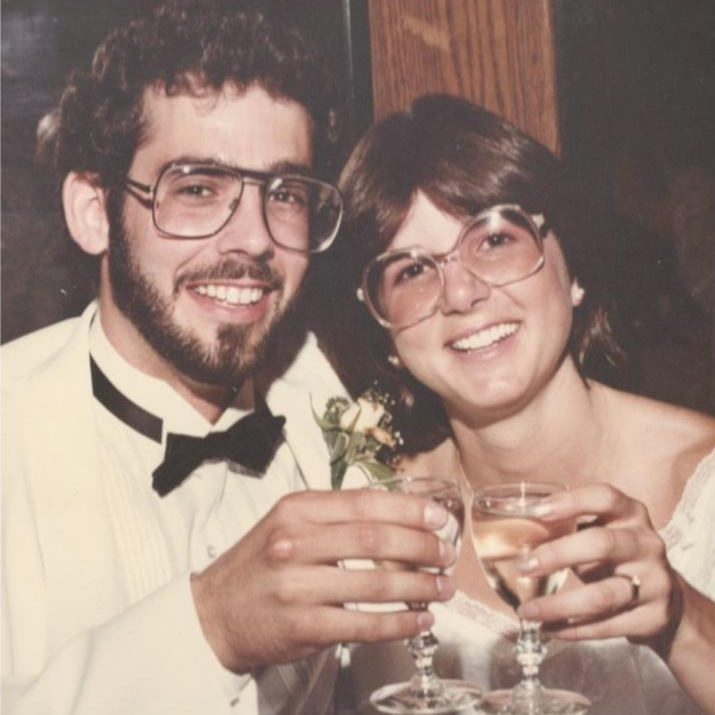
The Coffmans
Jamie and Cathy Coffman at their wedding, 41 years ago

The Rudolfs
Mitch and Deb Rudolf at their wedding 40 years ago
Division of Labor
A lot of the caregiving also encompasses bill paying and doctor and hospital management.
Deb notes Mitch was assigned a doctor in the hospital, and they had to hope for the best. Insurance battles followed. “We’ve changed doctors multiple times—first due to COBRA ending, then Medicare not being accepted,” she explains. “Every time meant starting over, re-explaining his condition, his care needs, and what actually works for us.”
For the Coffmans, Jamie took care of the physical logistics. His office, an hour east from their Home in eastern Pennsylvania allowed him to start working from home full time. The hospital that Cathy attends in Hershey PA is an hour west from their home. Jamie was able to manage his schedule so that he can take Cathy to all of her appointments.
As Mitch’s caregiver, Deb Rudolf manages all the logistics—scheduling, insurance, billing, disputes. “I was told to keep a notebook. I tried, but eventually created my own system: organized folders, logs, screenshots, and a lot of persistence,” she says. “I’ve been called about bills already paid and had to pull up receipts to prove it. You have to stay sharp, because mistakes are common—and they can cost you.”
Cathy manages the medical bills for the Coffmans. “It alone feels like a full-time job,” she says.
Jamie and Deb both say the early days of caregiving were overwhelming. “I remember one morning—it took three hours just to help Mitch out of bed, into the bathroom, and through a shower. I hadn’t even had coffee yet,” says Deb. “I thought, How are we going to do this every day? But things improved. Slowly, Mitch regained strength and independence—showering, dressing, even tying his own shoes. That was a big win.”
Home Improver
“I’ve learned to do things I never expected—home repairs, tech setups, plumbing fixes. I wouldn’t call myself a home expert, but I manage,” says Deb. “What I’ve lost is solitude. In our old home, we had separate spaces. Now we’re together 24/7, and that’s hard—even when you love someone. You get on each other’s nerves, but you adapt.”
For Jamie, ever the engineer, he says he’s had to adjust his time management. He’s also disappointed. “We’ve given up the spontaneity that comes with the limited mobility of my spouse. The range of activities we like to do, like hiking, camping, and going to events that depend on us being mobile,” he says. “So yeah, there are times I’m disappointed and frustrated.”
Both couples are in the process of adapting their homes. “Thank goodness we bought a single-level home, thinking I’d be the one with mobility issues (I’ve had a knee replacement),” says Deb.
Cathy and Jamie have been in their home for 35 years; they have no intention of leaving it. They need a stairlift, so Cathy can get to the second floor. (Now, Jamie or her oldest son help carry her upstairs for a shower).
Caregiver Disappointments
Emotionally caregiving takes a toll on both the able-bodied spouse and the caregiver.
“Emotionally, I’ve had to slow down.” Admits Deb Rudolf. “I used to move fast and loud—always doing. Now I take things as they come.” The Rudolfs were surprised by the support they got; even from 3000 miles away.
The Coffmans have always been self-reliant almost to a fault. “It’s been a blessing for us to have the amount of people that have shown up to help when things started falling apart,” says Cathy.
Deb says, “We still try to find joy. We go to plays, concerts, and dinners. We just plan more carefully now.”
Adjustment is the Key
For both couples, the dynamic between them has changed—both are together constantly. “We’ve always agreed on the big things: parenting, values, priorities,” says Deb. “We still do. It just takes more effort now to find space for us alone.”
Jamie Coffman says, “For me, one of the biggest struggles is getting over the disappointment, and resentment at the situation [Cathy’s lack of mobility] … has stolen and will continues to steal future things that are not possible.”
“I’m tough on the situation, maybe I’m more selfish than other spousal caregivers,” he says.
Or maybe, he says what others think but do not speak about?
Deb Rudolf has an excellent perspective:
“To any caregiver reading this: You’re doing more than you think. It’s okay to feel overwhelmed. Just focus on what you can do. Celebrate the wins—however small—and know that you’re not alone.”